A home’s drainage system consists of two primary components: the building drain system and the sewer line.
Building drain lines include plumbing located within or beneath the structure that collect wastewater from fixtures. The sewer line begins where the building drain exits the structure and runs underground to a city sewer, private sewer, or septic system.
Common Sewer Line Materials
VCP (Vitrified Clay Pipe)
Vitrified clay pipe is commonly found in older Los Angeles-area homes. It is highly resistant to corrosion and can last many decades under favorable conditions. However, clay is brittle and susceptible to cracking, joint separation, and root intrusion—particularly in areas with soil movement or mature landscaping.
Long lifespan when intact
Resistant to corrosion
Susceptible to root intrusion
Can crack or offset during earthquakes
CI (Cast Iron)
Cast iron sewer pipe was widely used in residential construction and typically has a service life of 40 to 80 years. Over time, corrosion and mineral buildup reduce interior diameter and flow capacity. Advanced deterioration can lead to channeling along the bottom of the pipe, wall thinning, cracking, or failure. .
Plastic piping, including ABS and PVC, is commonly used in modern sewer installations. When properly installed, plastic pipe offers smooth flow characteristics, resistance to corrosion, and long service life. Performance depends heavily on installation quality, bedding, and joint integrity.
A lightweight plastic sewer material.
Smooth interior promotes good flow
Resistant to corrosion
Can split or sag if improperly installed
Widely used in modern systems
PVC (Polyvinyl Chloride)
Another modern plastic alternative.
Stronger joints than ABS
Smooth interior
Long service life when properly installed
Requires proper bedding and slope
Concrete / Cement Pipe
Concrete sewer pipe was used in some older installations but is susceptible to deterioration over time, particularly when exposed to acidic wastewater or shifting soils. In many jurisdictions, including Los Angeles, unlined concrete pipe is generally no longer approved for new installations under public streets and may require rehabilitation when permits are pulled.
Durable but heavy
Susceptible to cracking and root intrusion
Repairs can be invasive
Orangeburg (Bituminous Fiber Pipe)
Orangeburg pipe is a fiber-based material made from tar-impregnated paper. It was commonly installed between the 1940s and 1970s and has a limited service life. As it deteriorates, the pipe may flatten, collapse, or allow root intrusion. Replacement is typically recommended when Orangeburg is present. .
Made from wood pulp and tar
Commonly installed from the 1940s–1970s
Softens, deforms, and collapses over time
Extremely vulnerable to root intrusion
Orangeburg is considered a failed material and should be replaced when discovered.
Cured-In-Place Pipe (CIPP) Liner
A Cured-In-Place Pipe (CIPP) liner is a trenchless rehabilitation method that creates a new pipe within an existing one. A resin-saturated liner is inserted, expanded, and cured to form a seamless interior surface. When properly installed, CIPP can restore structural integrity, seal defects, and extend the life of an existing sewer line.
• Creates a seamless, jointless pipe within the existing host pipe
• Commonly used to rehabilitate clay, cast iron, and concrete sewer lines
• Seals cracks, joint separations, and minor voids when properly installed
• Can extend the service life of an existing sewer line without excavation
• Final performance depends heavily on proper pipe preparation and curing process
• Does not correct existing bellies, improper slope, or severe misalignment
Picote Pipe Preparation Systems
Picote systems are mechanical pipe preparation tools used to remove scale, roots, and deteriorated material prior to lining or coating applications. While effective when properly used, inadequate preparation, moisture control, or improper coating application can result in premature failure, peeling, or delamination. As inspectors, we commonly document these failures during post-repair evaluations.
• Used to mechanically remove scale, corrosion, roots, and deteriorated pipe material prior to lining or coating
• Commonly used as a preparation step for CIPP liners or spray-applied coatings
• Can improve adhesion when surface preparation is performed correctly
• Improper use or inadequate preparation may result in premature liner or coating failure
• Failures observed during inspections often include peeling, delamination, or uneven coating thickness
Common Sewer Line Conditions
Root Intrusion - Root intrusion occurs when tree or plant roots enter the sewer line through joints, cracks, or material defects. This is a common condition in clay and older pipe systems. While minor root intrusion can often be managed with maintenance, advanced intrusion may restrict flow or indicate underlying structural issues.
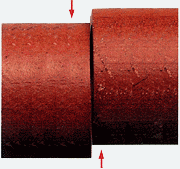
Offset Joints - An offset joint occurs when two connected pipe sections become misaligned. Minor offsets may not impact performance, but larger offsets can obstruct flow, prevent camera passage, and increase the risk of debris accumulation or future separation.
Bellied Pipe - A bellied pipe is a section of sewer line that has sagged, creating a low point where water and debris collect. This condition disrupts proper drainage and cannot be corrected through cleaning or lining. Repair typically requires excavation and reinstallation with proper slope at A minimum of 1/4 inch of fall per linear foot.
Channeling - Channeling is commonly observed in aging cast iron pipes where corrosion and wear create a trough along the bottom of the pipe. While wastewater may still flow, the remaining pipe walls may be significantly weakened and prone to failure.
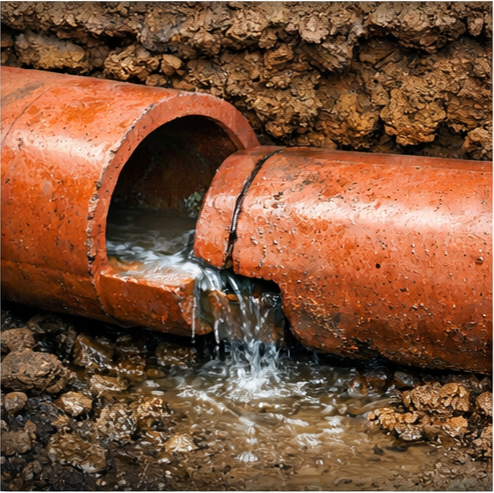
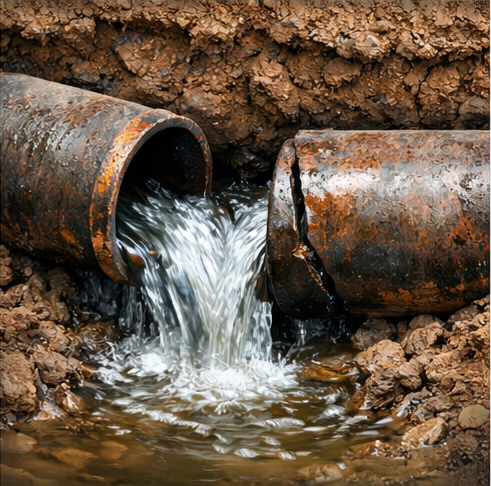
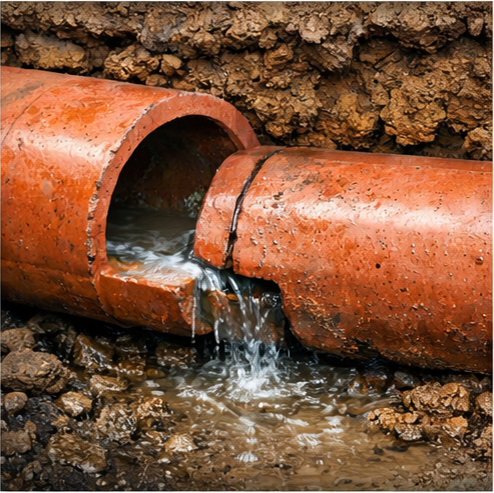
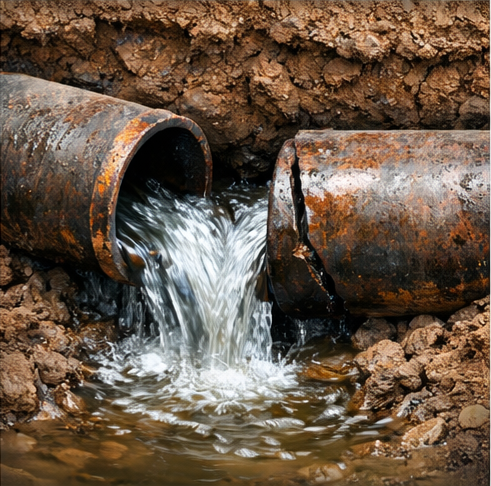
Pipe Separation - Pipe separation occurs when two sections of sewer pipe fully disconnect. This condition can allow wastewater to escape into surrounding soil, potentially causing voids, soil loss, or surface collapse. Separation is considered a serious defect requiring repair.
Sewer Lateral Responsibility
In most Los Angeles-area jurisdictions, the homeowner is responsible for the sewer lateral from the structure to the city main, even when portions of the line run beneath sidewalks or streets. Repairs typically require proper permitting and use of city-approved contractors.
Common Sewer Terms Explained
Cleanout
An access point that allows inspection and maintenance of the sewer line.
Required for proper servicing
Often located near the home or property line
Lack of cleanouts limits inspection capability
Building Drain
The portion of piping inside or directly under the structure.
Sewer Lateral
The pipe running from the building to the city sewer connection.
City Connection
The point where private sewer piping connects to the municipal sewer system.
Hydro Jetting
A high-pressure water cleaning method.
Effective for roots and buildup
Not always suitable for older or deteriorated pipes
Camera Inspection
A visual evaluation using a sewer camera.
Allows real-time assessment
Documents actual conditions instead of assumptions